How Contractors Can Increase Door Job Profits
Category: Contractor Strategy
Most contractors don’t lose money on door jobs because of material cost.
They lose it through:
- Callbacks
- Underpricing
- Poor upgrade structure
- Wasted install time
- Avoidable framing mistakes
Door work can be profitable.
But only when it’s structured properly.
Let’s break it down.
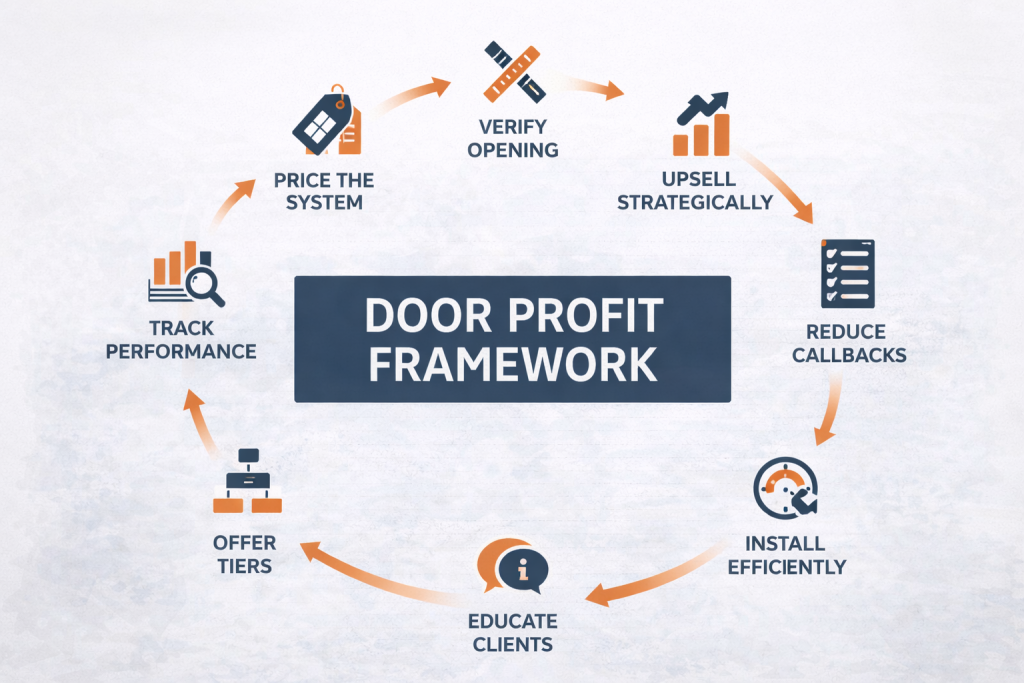
Price the System — Not Just the Slab
One of the biggest profit leaks is quoting only the door panel.
A door job includes:
- Slab or prehung unit
- Hardware
- Hinges
- Jamb extension (if needed)
- Flashing (exterior)
- Shimming & fastening
- Disposal of old unit
- Trim touch-ups
When you quote only the slab, you leave margin on the table.
Structure your estimate as a complete door system.
Clients understand clarity.
And clarity protects margin.
Standardize Rough Opening Verification
A tight rough opening costs time.
Time kills profit.
Before ordering:
- Confirm width (Door + 2″)
- Confirm height (Door + 2″)
- Confirm plumb and square
- Confirm finished floor height
I’ve seen installs that should take 90 minutes turn into half-day jobs because framing wasn’t verified first.
Measure twice.
Order once.
Install smoothly.
Upsell Strategically — Not Aggressively
Upselling isn’t about pressure.
It’s about explaining value.
Examples:
- Hollow core → solid core upgrade
- Standard hinges → heavy-duty hinges
- Basic lockset → upgraded hardware
- Standard threshold → adjustable threshold
- Add flashing and sill pan (exterior)
When framed as performance upgrades, clients often choose higher quality.
That increases margin without increasing labor dramatically.
Reduce Callbacks
Callbacks are profit killers.
Most door callbacks come from:
- Sagging hinges
- Improper shimming
- Weak anchoring
- Inadequate sealing
- Rushed installs
Each callback eats:
- Fuel
- Labor time
- Schedule space
- Reputation
Investing 10 extra minutes during install often saves hours later.
Clean installs protect profit.
Offer Tiered Door Packages
Instead of giving one price, structure three options:
Basic Package
- Hollow core
- Standard hinges
- Standard hardware
Performance Package
- Solid core
- 3 hinges
- Mid-grade hardware
Premium Package
- Solid core
- Heavy-duty hinges
- Upgraded hardware
- Trim finishing
- Enhanced sealing (exterior)
Clients prefer choosing between options instead of negotiating price.
Structured choices increase average ticket value.
Improve Installation Efficiency
Profit increases when installs become predictable.
Predictability comes from:
- Proper rough openings
- Using prehung units when appropriate
- Correct fastener lengths
- Pre-cut shims ready
- Clear workflow
When the system is correct, install time shrinks.
Time saved equals margin gained.
Educate Clients During Estimate
Explaining why:
- A solid core door improves privacy
- A proper threshold prevents drafts
- Heavy hinges prevent sagging
Builds trust.
Trust reduces price resistance.
The more a client understands performance, the less they focus on cost alone.
Track Door Job Performance
Few contractors track:
- Install time
- Material margin
- Callback frequency
Tracking reveals patterns.
Patterns reveal leaks.
Leaks cost money.
Even basic tracking improves decision-making.
Final Thoughts
Door jobs aren’t low-margin by default.
They become low-margin when:
- Scope is unclear
- Framing is ignored
- Upgrades aren’t offered
- Callbacks aren’t prevented
When you price the system, verify the structure, and control installation variables, door jobs become predictable and profitable.
Profit follows process.
—
The Door Authority
Expert Door Systems for Canadian Homes