Hollow Core vs Solid Core Doors: What’s the Real Difference?
Category: Materials & Performance
At first glance, hollow core and solid core doors can look almost identical.
Same panel design.
Same finish options.
Same hardware.
But once installed, they perform very differently.
And in my experience, most homeowners choose based on price — without understanding what they’re trading off long term.
Let’s break down the real differences.
What Is a Hollow Core Door?
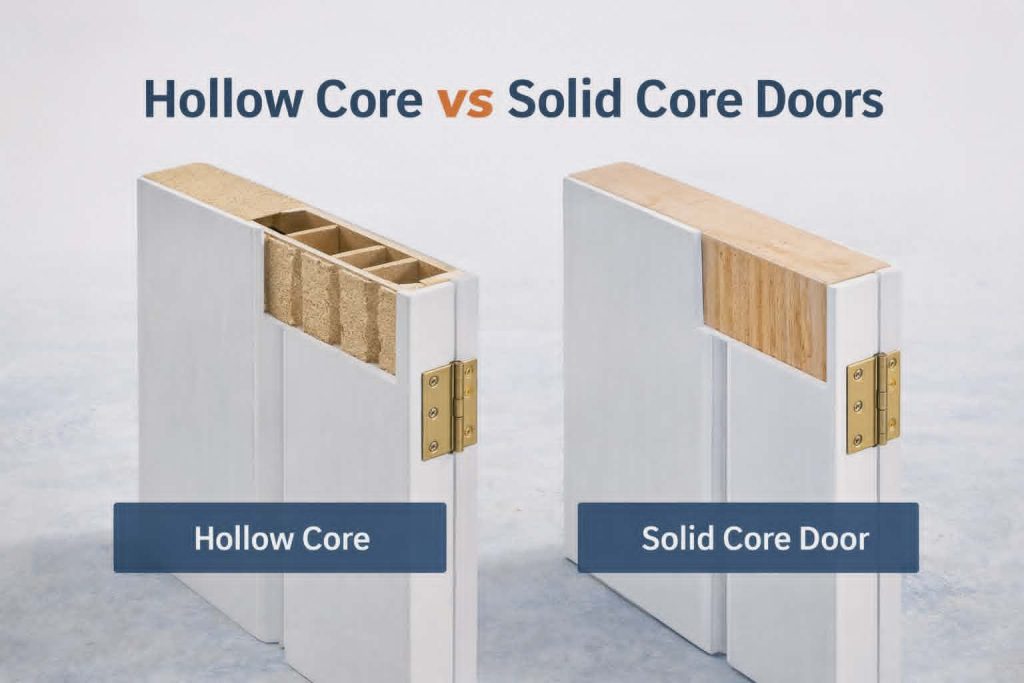
A hollow core door isn’t completely hollow.
Inside, it typically contains:
- A cardboard or fiber honeycomb core
- Thin wood or MDF skins
- A lightweight perimeter frame
They’re designed to be:
- Lightweight
- Cost-effective
- Easy to install
- Common in new construction
Because they’re light, they place minimal stress on hinges and framing. That’s one reason builders use them in large quantities.
But lightweight also means less mass — and mass affects performance.
What Is a Solid Core Door?
A solid core door contains:
- Solid composite wood fiber core (most common)
- Or engineered wood construction
- Thicker outer skins
They are significantly heavier than hollow core doors.
That added weight changes:
- Sound control
- Door feel
- Hinge load
- Durability
When you close a solid core door, it doesn’t sound hollow or sharp. It closes with a lower, more controlled tone.
That difference alone often surprises homeowners.
Sound Control: The Biggest Difference
If privacy matters, solid core wins.
Hollow core doors allow sound to transfer easily between rooms. In bedrooms, offices, or bathrooms, that can become noticeable quickly.
Solid core doors reduce sound transmission because:
- More mass blocks vibration
- Thicker construction absorbs sound
In homes with home offices or teenagers, this upgrade alone often justifies the cost difference.
Durability & Long-Term Wear
Over time, hollow core doors can:
- Dent easily
- Crack at edges
- Delaminate if exposed to moisture
Solid core doors resist impact better and feel more substantial in daily use.
That said, heavier doors require:
- Proper hinge screws (into framing, not just jamb)
- Adequate shimming
- Correct alignment during installation
I’ve seen solid core doors sag — not because of the door itself, but because the hinge anchoring wasn’t upgraded to match the weight.
The door material and installation method must match.
Cost Differences
Hollow core doors are generally:
- 30–50% less expensive
- Common in budget builds
- Faster to install
Solid core doors:
- Cost more upfront
- Add perceived quality
- Improve resale appeal
The price gap narrows when you factor in long-term durability and performance expectations.
Weight & Structural Impact
Here’s something often overlooked:
A heavier door transfers more load into:
- Hinges
- Jamb
- Rough opening framing
If the rough opening wasn’t framed square or the hinge side isn’t properly supported, solid core doors will expose those weaknesses faster.
That’s not a flaw in the door.
It’s a system issue.
(Internal link: Rough Opening Formula Explained)
(Internal link: What Is a Door System?)
Where Each Type Makes Sense
Hollow Core Doors Work Well For:
- Closets
- Low-traffic rooms
- Budget-conscious builds
- Large developments
Solid Core Doors Make Sense For:
- Bedrooms
- Bathrooms
- Offices
- Homes prioritizing quiet
- Higher-end renovations
It’s not about one being “good” and the other “bad.”
It’s about matching performance to expectations.
The Feel Factor (Often Underrated)
Beyond numbers and specs, there’s the daily experience.
Solid core doors:
- Feel substantial
- Close with authority
- Reduce vibration
Hollow core doors:
- Feel light
- Can sound sharp when closed
- Transfer more room noise
When homeowners upgrade one door as a test — usually a bedroom — they often end up replacing the rest later.
Final Thoughts
The real difference between hollow core and solid core doors isn’t appearance.
It’s performance.
- Sound control
- Durability
- Structural load
- Overall feel
If you’re building for short-term cost efficiency, hollow core works.
If you’re building for long-term comfort and quality, solid core is usually worth the investment — provided the installation supports it properly.
Doors are part of a system.
And the right choice depends on how that system is built.
—
The Door Authority
Expert Door Systems for Canadian Homes