What Is a Door System? (And Why It’s More Than Just a Slab)
Category: Installation & Framing
Most people think a door is just a panel that swings open and closed.
It isn’t.
In practice, a door is a complete system made up of structural, mechanical, and sealing components working together. When one part is ignored, performance suffers.
From what I’ve seen on installs and callbacks, most door problems don’t start with the slab.
They start with the system around it.
Let’s break that down clearly.
A Door Is More Than the Slab
The slab is only one part of the system.
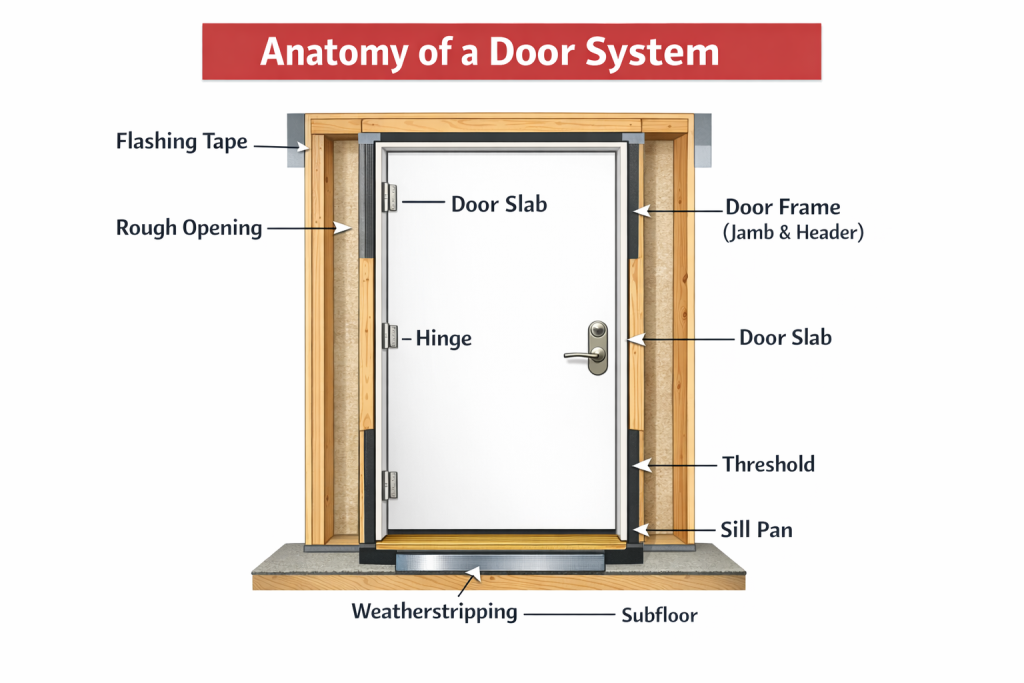
A complete door system includes:
- The slab (the door itself)
- The frame (jamb and head)
- Hinges
- Strike plate
- Lockset hardware
- Rough opening
- Shimming and fasteners
- Weatherstripping (exterior)
- Threshold (exterior)
- Flashing and sealing (exterior)
If any one of these components is installed incorrectly, the entire system is compromised.
I’ve seen doors replaced unnecessarily when the real issue was a twisted frame or weak hinge anchoring.
The slab usually isn’t the problem.
The Door System Starts at the Rough Opening
Before the door is even delivered, the system begins with framing.
The rough opening must be:
- Correct width (Door width + 2 inches)
- Correct height (Door height + 2 inches)
- Square
- Plumb
- Level
If the rough opening is off, everything after becomes adjustment work instead of controlled installation.
On renovation jobs especially, small framing shortcuts show up later as sticking, sagging, or uneven gaps.
(Internal link: Rough Opening Formula Explained)
Framing accuracy determines installation success.
The Frame Is Structural — Not Decorative
The jamb and head are not just trim pieces.
They control:
- Alignment
- Reveal spacing
- Hinge support
- Latch alignment
A twisted or poorly shimmed frame causes:
- Doors that won’t latch
- Uneven reveals
- Sagging over time
- Hardware stress
In many cases, switching from slab replacement to a properly installed prehung unit eliminates these variables entirely.
(Internal link: Prehung vs Slab Doors)
The frame carries load. It is structural.
Hinges Carry the Load
Door weight matters more than most people think.
Hollow core and solid core doors behave very differently under hinge load.
Heavier doors require:
- Stronger hinges
- Proper screw length into framing
- Solid shimming behind hinge locations
I’ve seen solid core doors installed with short screws into jamb material only. They hold for a while — then they sag.
Hardware decisions are system decisions.
(Internal link: Hollow Core vs Solid Core Doors)
Exterior Doors Are Protection Systems
Exterior doors must do more than open and close.
They must:
- Prevent air infiltration
- Prevent water intrusion
- Withstand seasonal temperature swings
- Integrate with flashing
- Maintain threshold compression
When exterior doors fail, it’s rarely because of the panel.
It’s usually:
- Improper flashing
- Weak sealing
- Incorrect threshold setup
- Poor integration with the building envelope
Exterior doors are part of the structure’s defense system.
Not just an entry point.
Interior Doors Still Require System Thinking
Even interior doors affect:
- Sound transfer
- Privacy
- Frame stability
- Long-term hinge alignment
When a door swings open on its own or rubs the jamb, that’s typically a system issue — not a manufacturing defect.
System thinking applies everywhere, not just outside.
Common Door System Failures
Most door problems I’ve seen trace back to:
- Incorrect rough openings
- Insufficient shimming
- Weak hinge anchoring
- Frame misalignment
- Ignored floor height
- Inadequate sealing
Treating a door as a slab creates reactive installs.
Treating it as a system creates predictable performance.
Why System Thinking Matters
When doors are treated as products, the focus stays on:
- Style
- Finish
- Price
When doors are treated as systems, the focus shifts to:
- Structure
- Load distribution
- Alignment
- Sealing
- Long-term performance
That shift changes installation quality significantly.
It also reduces callbacks.
Final Thoughts
A door is not just a panel in a wall.
It is a coordinated system of framing, alignment, hardware, and sealing components working together.
When installed properly, it performs quietly for years.
When installed poorly, small issues compound over time.
Before replacing a slab, step back and evaluate the system around it.
Most problems start there.
—
The Door Authority
Expert Door Systems for Canadian Homes